
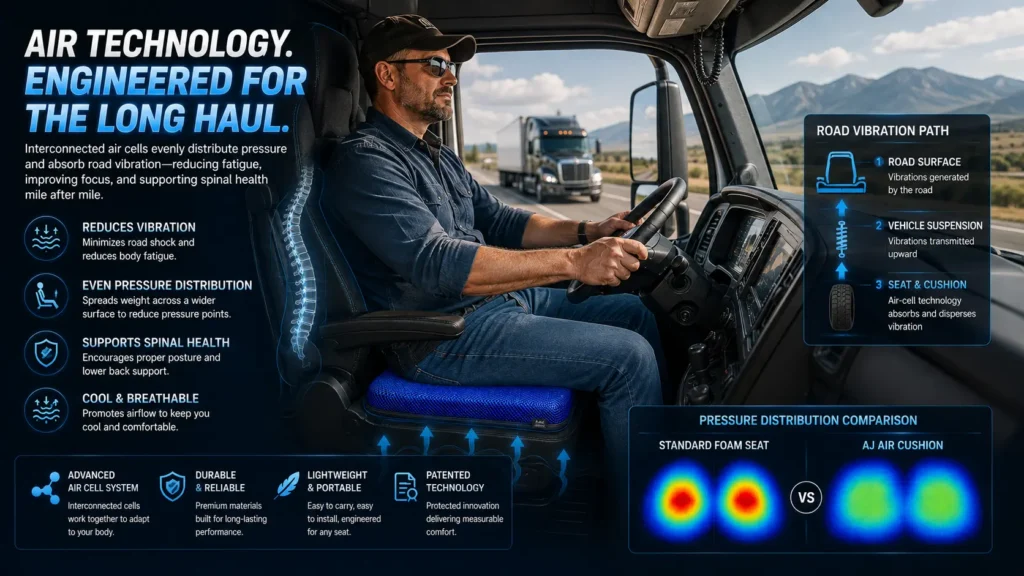
For commercial drivers, a seat is not simply part of a vehicle interior.
It is a workstation.
Long-haul truck drivers, delivery operators, bus drivers, equipment operators, and other transportation professionals may spend substantial portions of their working day seated while simultaneously being exposed to road vibration, constrained posture, repeated vehicle entry and exit, and limited opportunities for movement.
For fleet operators, this makes seating ergonomics an occupational-design issue as well as a comfort issue.
Research does not support the simplistic claim that “sitting alone causes back pain.” The relationship is more complex. Evidence suggests that prolonged sitting becomes more relevant when combined with factors such as awkward posture and whole-body vibration, both of which are common in professional driving environments.
Understanding these interactions can help fleet managers evaluate seating products more intelligently.
Why Professional Driving Is Different From Ordinary Sitting
An office employee and a long-haul truck driver can both spend hours seated, but their mechanical environments are very different.
Professional drivers may experience:
- continuous low-frequency vehicle vibration;
- repeated road shocks;
- prolonged hip and knee flexion;
- limited posture variation;
- steering and pedal constraints;
- asymmetrical reaching;
- long uninterrupted sitting periods.
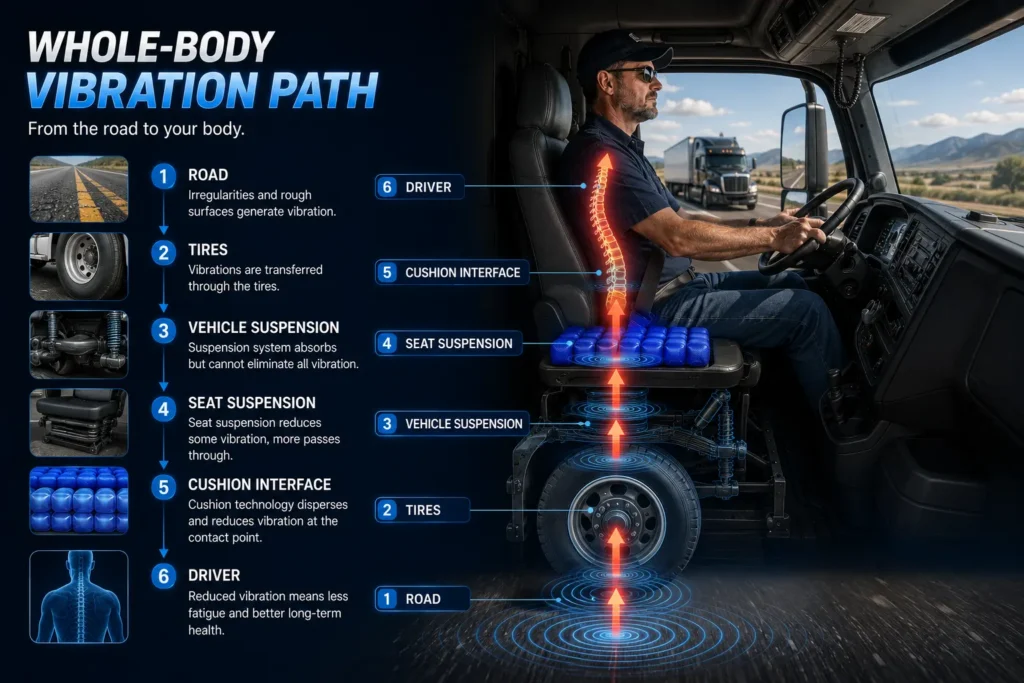
Whole-body vibration, commonly abbreviated WBV, refers to mechanical vibration transmitted through supporting surfaces such as a vehicle seat into the human body.
Occupational studies have repeatedly investigated the relationship between WBV and low-back symptoms among professional drivers.
A longitudinal investigation by Bovenzi examined vibration exposure among drivers and found exposure-response relationships between whole-body vibration metrics and low-back-pain outcomes.
The implication for fleet ergonomics is straightforward:
Vehicle seating must manage more than static body weight. It is part of a dynamic mechanical system involving the road, suspension, vehicle seat, driver posture, and duration of exposure.
Whole-Body Vibration Cannot Be Solved by a Cushion Alone
A seat cushion should never be presented as a replacement for vehicle suspension engineering.
Research in truck drivers illustrates this clearly.
Dennerlein and colleagues conducted a randomized controlled trial involving drivers from a major U.S. trucking company. The study compared an active electromagnetic seat-suspension system with a passive air-suspension seat.
The active system significantly reduced measured WBV exposure, although improvements in low-back-pain outcomes appeared to involve multiple factors rather than vibration reduction alone.
This is an important lesson for fleet procurement.
Driver ergonomics should be approached as a system:
Vehicle suspension
→ Seat suspension
→ Seat geometry
→ Support surface
→ Driver posture
→ Work-rest pattern
An aftermarket seat cushion operates only at one layer of this system.
Its role is therefore better described as improving the body-seat interface and adjustable seated support, not eliminating vehicle-generated vibration or treating musculoskeletal disorders.
That distinction keeps product claims technically credible.
Prolonged Static Sitting Is Another Important Variable
Vibration is only part of the problem.
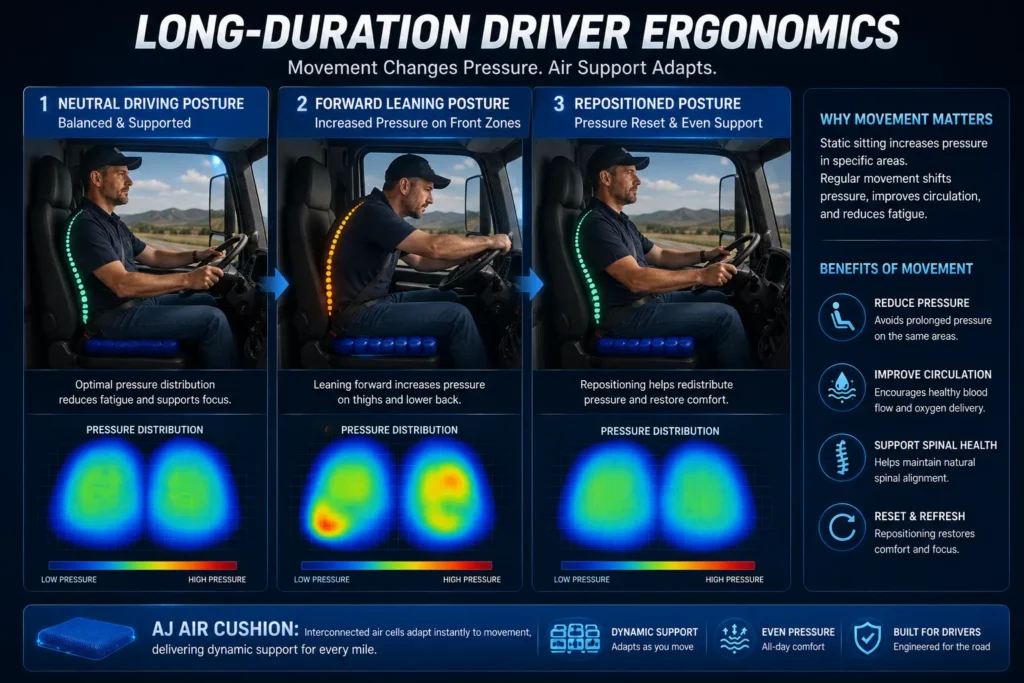
Humans are poorly suited to maintaining one posture indefinitely.
A field study of office workers by Mörl and Bradl found that approximately 82% of measured work time was sedentary. During relaxed seated postures, very low lumbar-muscle activation was frequently observed, placing greater loading demands on passive spinal structures.
Although office workers and commercial drivers operate in different environments, the study illustrates a fundamental ergonomic principle:
Static posture and lack of movement matter.
More recent intervention research provides additional evidence.
A 2024 six-month cluster-randomized controlled trial studied office workers at elevated risk of neck and low-back pain. Participants using a dynamic seat cushion designed to encourage postural shifts showed substantially lower incidence of newly developed neck and low-back pain than participants using a placebo seat pad.
The important mechanism proposed by the researchers was not simply “more padding.”
It was postural variation.
For seating designers and fleet buyers, that is a major distinction.
Why Adjustable Air Support Is Relevant to Fleet Seating
Professional drivers vary in:
- body weight;
- stature;
- pelvic geometry;
- preferred seating position;
- truck seat design;
- suspension setting;
- route conditions;
- driving duration.
A single fixed cushion firmness is unlikely to feel optimal to every driver.
Adjustable air support offers a different approach because internal pressure can be altered after the product is manufactured.
This gives the user some control over the body-seat interface.
Depending on the design, interconnected air cells may also respond to weight shifts as the driver changes position.
For fleets, these characteristics can be valuable because the same basic product platform can accommodate a broader range of users than a single fixed-density material.
Learn more about our commercial fleet applications and professional seating solutions.
AJ AIR CUSHION’s current B2B seat platform combines interconnected air cells, built-in inflation and release controls, breathable 3D mesh, TPU/Lycra construction, and a non-slip base.Explore our adjustable air seat cushion products for commercial and professional seating programs. Its B2B site specifically positions the platform for commercial vehicles and fleet applications.For additional technical documentation, see our Technology & Patents page.
Pressure Distribution in the Driver-Seat Interface
Another factor is how the driver’s body load is distributed across the seat.
Research from wheelchair and rehabilitation seating cannot be directly translated into trucking outcomes, but it does provide useful biomechanical evidence concerning support surfaces.
Comparative studies have shown that cushion type can meaningfully change interface-pressure distribution, and air-based cushions have performed well in several controlled comparisons.
For vehicle applications, this suggests that fleet evaluations should look beyond subjective softness.
Relevant questions include:
- Does the cushion increase the effective contact area?
- Are concentrated loading areas reduced?
- Can firmness be adjusted for different drivers?
- Does the cushion remain stable during braking and steering?
- Does it interfere with seat controls or driving posture?
- Is the height appropriate for pedal and steering-wheel ergonomics?
- Can the cover manage heat during long shifts?
- Can the product withstand repetitive commercial use?
These are procurement questions, not merely consumer comfort questions.
Cushion Height Is an Often-Ignored Fleet Consideration
Adding any aftermarket cushion changes the driver’s seated height.
That can alter:
- eye position;
- steering-wheel relationship;
- hip angle;
- knee position;
- pedal reach;
- headroom;
- seat-belt geometry.
Therefore, thicker is not necessarily better.
Fleet buyers should evaluate the cushion together with the existing vehicle seat rather than treating the cushion as an isolated accessory.
A support product should improve the seating interface without compromising the original workstation geometry.
This is particularly important when standardizing a product across several truck, van, or commercial-vehicle models.
Breathability and Thermal Comfort During Long Shifts
Long-duration sitting also creates a thermal environment between the body, clothing, cushion cover, and seat.
Heat and moisture management influence perceived comfort and may become particularly relevant in warm climates and long shifts.
Research using infrared thermography has demonstrated measurable differences in the heating and cooling behavior of various cushion constructions. Ferrarin and Ludwig, for example, observed different thermal transients among air-filled, gel, foam, and mixed-structure cushions.
More recent systematic-review evidence confirms that cushion microclimate is influenced by material architecture and that no single cushion category should automatically be assumed to outperform every other configuration.
For fleet products, this supports combining pressure-management design with breathable cover construction rather than focusing exclusively on the internal cushion material.
What Fleet Procurement Teams Should Evaluate
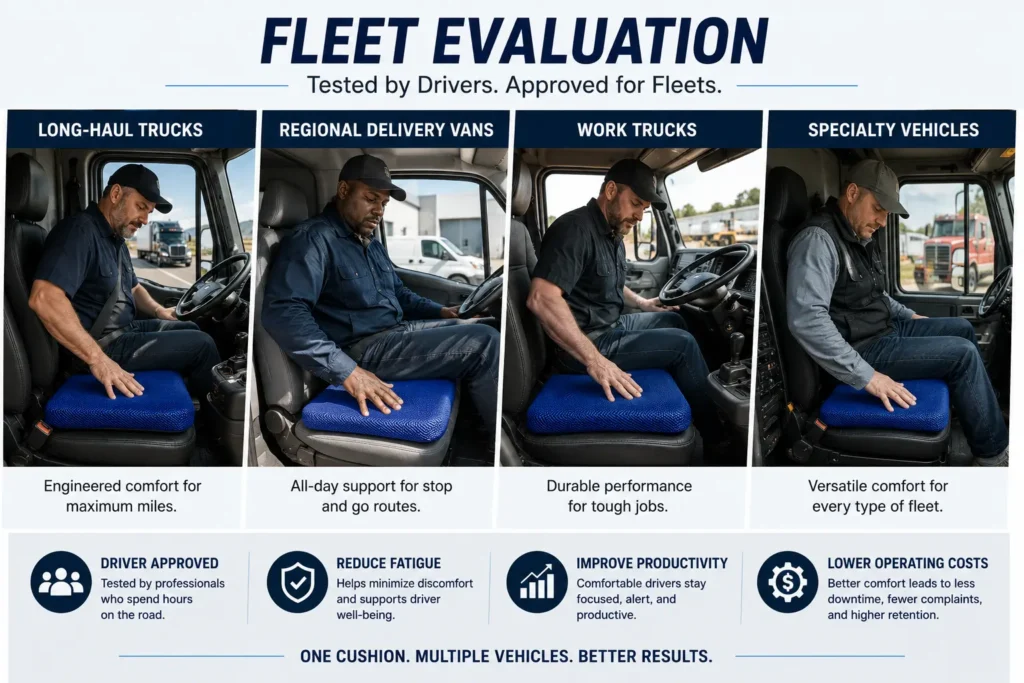
Before deploying a seating accessory across a professional fleet, consider a structured evaluation.
1. Driver Fit
Test the product across different body sizes and seating preferences.
2. Vehicle Compatibility
Confirm that the cushion fits the seat base without interfering with controls, seat belts, steering, pedals, or suspension operation.
3. Adjustable Support
Determine whether drivers can meaningfully customize firmness.
4. Stability
Evaluate movement during acceleration, braking, cornering, entry, and exit.
5. Long-Shift Comfort
Short showroom tests are insufficient. Trial the product during representative routes.
6. Temperature and Cover Performance
Assess breathability, cleaning requirements, and durability.
7. User Compliance
The best ergonomic product provides little value if drivers remove it because adjustment is difficult or inconvenient.
8. Replacement and Maintenance
Fleet products require straightforward maintenance procedures and predictable replacement cycles.
Pilot Programs Are Better Than Assumptions
Large fleet purchases should ideally begin with controlled field evaluations.
A practical pilot might involve:
- 20–50 drivers
- Several vehicle types
- 30–60 days of use
- Standardized driver feedback
- Product inspection after the trial
Data can include:
- perceived seated comfort;
- ease of adjustment;
- heat perception;
- stability;
- preference versus existing seating;
- product condition after repeated use.
This approach does not replace formal ergonomic or clinical testing, but it gives procurement teams operational evidence before committing to large-volume orders.
AJ AIR CUSHION’s B2B partnership model currently includes sample evaluation, product selection, commercial terms, production planning, and wholesale/fleet deployment discussions.
A Responsible Position on Driver Health Claims
Fleet buyers should be cautious of products promising to “cure back pain,” “repair the spine,” or “eliminate vibration.”
The scientific evidence does not justify such blanket statements.
Professional-driver discomfort is multifactorial.
Road vibration, vehicle suspension, work schedules, posture, seat geometry, physical conditioning, individual health status, and psychosocial factors can all contribute.
A well-engineered cushion should therefore be positioned as one component of a broader seating and ergonomic strategy.
That is both scientifically defensible and more credible to professional buyers.
Conclusion
Commercial driver seating should be treated as workstation engineering.
Research shows that whole-body vibration, posture, and prolonged static sitting all deserve consideration in professional driving environments. Seat-suspension research also demonstrates that improvements in driver comfort and low-back outcomes are rarely attributable to a single variable.
For fleet operators, an adjustable air cushion can provide a practical additional layer between the driver and the vehicle seat—particularly when the product offers pressure redistribution, user-adjustable firmness, breathable materials, and stable positioning.
The most effective fleet strategy is therefore not:
“Buy a softer seat.”
It is:
“Build a better driver-seat system.”
References
- Dennerlein JT, Cavallari JM, Kim JHJ, Green NH. The effects of a new seat suspension system on whole body vibration exposure and driver low back pain and disability: Results from a randomized controlled trial in truck drivers. Applied Ergonomics. 2022;98:103588. DOI: 10.1016/j.apergo.2021.103588.
- Bovenzi M. Metrics of whole-body vibration and exposure-response relationship for low back pain in professional drivers. Occupational and Environmental Medicine literature.
- Mörl F, Bradl I. Lumbar posture and muscular activity while sitting during office work. Journal of Electromyography and Kinesiology. 2013;23(2):362–368. DOI: 10.1016/j.jelekin.2012.10.002.
- Channak S, Speklé EM, van der Beek AJ, Janwantanakul P. The effectiveness of a dynamic seat cushion in preventing neck and low-back pain among high-risk office workers: a 6-month cluster-randomized controlled trial. Scandinavian Journal of Work, Environment & Health. 2024;50(7):555–566. DOI: 10.5271/sjweh.4184.
- Ferrarin M, Ludwig N. Analysis of thermal properties of wheelchair cushions with thermography. Medical & Biological Engineering & Computing. 2000;38(1):31–34. DOI: 10.1007/BF02344685.
Request a Commercial Fleet Evaluation
Tell us about your vehicles, driver profiles and estimated quantities. Contact our B2B team for fleet, sample or wholesale information.
Request fleet or wholesale pricing for samples, volume purchasing, or commercial evaluation.