
The True Cost of Sedentary Ergonomics in Modern Workforces
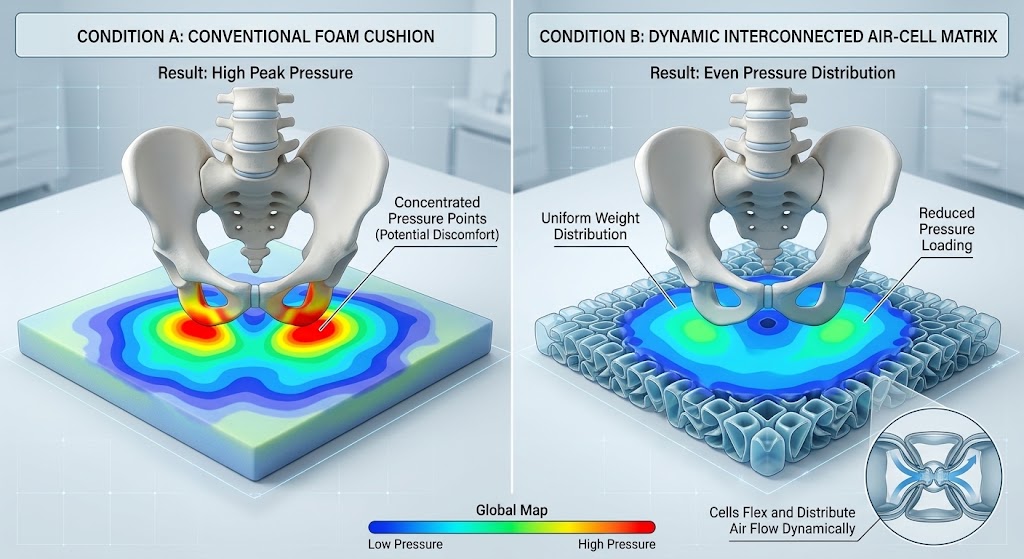
Extended sitting has evolved from a workplace inconvenience into a recognized corporate health liability. In the United States, musculoskeletal disorders (MSDs) attributable to sedentary desk posture account for over $50 billion annually in direct medical costs and lost productivity. Traditional corporate seating investments often rely on viscoelastic memory foam or molded polyurethane. However, emerging biomechanical evidence demonstrates that static foam substrates create systemic ergonomic failure points over long work shifts.
+-------------------------------------------------------------------------+
|                  STATIC FOAM vs. DYNAMIC AIR-CELL                       |
|                                                                         |
|  [ Static Foam / Memory Foam ]         [ Interconnected Air-Cells ]     |
|   • Compresses & bottoms out            • Dynamic fluid displacement    |
|   • Traps body heat (insulator)         • Passive convective airflow    |
|   • High peak pressure (>80 mmHg)       • Micro-pressure relief (<32 mmHg)
+-------------------------------------------------------------------------+
Biomechanical Insights: What the Clinical Literature Reveals
- Static vs. Dynamic Pressure DistributionResearch published in Applied Ergonomics underscores that continuous peak interface pressure exceeding capillary closing pressure (approximately $32\text{ mmHg}$) over the ischial tuberosities rapidly accelerates tissue ischemia and muscular fatigue. Static polyurethane foams deform progressively under constant load, losing elasticity within hours and concentrating the user’s upper body mass onto localized contact areas.
- Spinal Compression and Pelvic TiltAccording to studies in Spine and the Journal of Biomechanics, sustained seated postures with poor pressure offloading trigger posterior pelvic tilt, flattening the natural lumbar lordosis and escalating intradiscal pressure at the L4–L5 and L5–S1 segments by up to 40% compared to standing.
“Dynamic seating interventions that facilitate micro-movements and active weight redistribution significantly attenuate peak contact pressure and mitigate postural rigidity across prolonged computer tasks.”
— Adapted from Ergonomics & Applied Biomechanics literature
The AJ Air Cushion Engineering Advantage
Patented air-cell technology (protected under US Patents US 11,639,041 B2 and US 12,234,880 B2) transitions seating ergonomics from passive resistance to active hydrostatic equalization:
- Interconnected Multi-Chamber Matrix: Air flows smoothly between interconnected chambers, automatically redistributing load away from the sacrum and coccyx toward the broader thigh zones.
- Integrated Micro-Circulation Channels: Unlike dense memory foam that acts as a thermal trap, the spaced air-cell array establishes natural chimney-effect airflow channels, dissipating seated heat and moisture.
- Tool-Free Custom Calibration: Built-in press inflation allows enterprise users to adjust internal firmness independently to suit varying body types.
For enterprise buyers and workplace safety directors, upgrading existing seating assets with modular air-cell cushions delivers clinical-grade ergonomic protection at a fraction of full chair-replacement cycles.
Plan a Workplace Seating Program
Explore our wholesale air cushion products, review the patented technology, or request OEM and corporate purchasing information.