
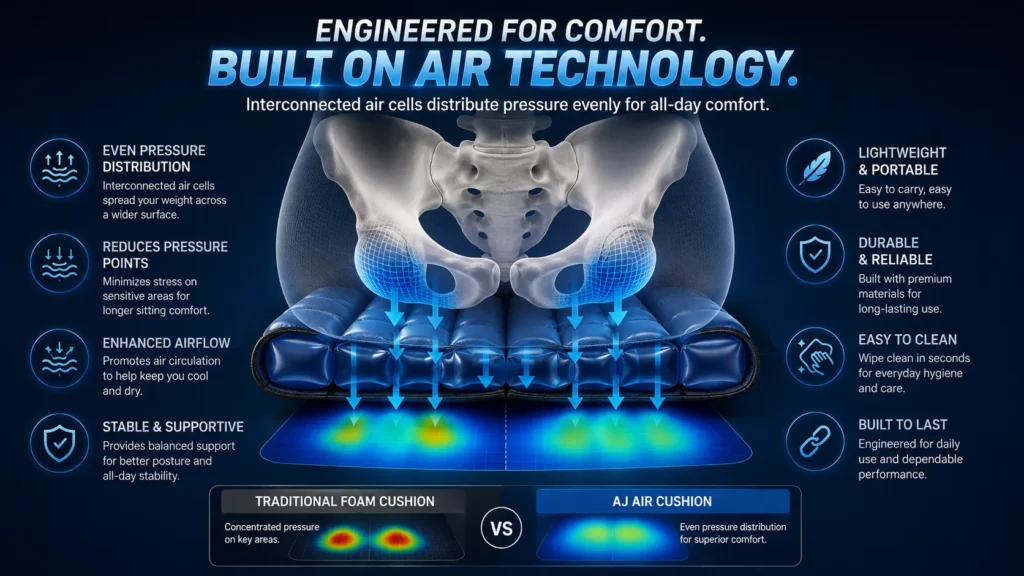
Modern seating is no longer evaluated only by how soft it feels during the first few minutes of use. For professional drivers, office employees, wheelchair users, corporate buyers, mobility specialists, and ergonomic-product distributors, one of the more useful engineering questions is:
How does a seating surface manage the forces between the human body and the seat over time?
This is where interface pressure and pressure redistribution become important.
Air-cell cushions represent one approach to seating design in which body weight is supported by multiple air-filled chambers rather than a single homogeneous block of foam. Research conducted primarily in rehabilitation and wheelchair seating has shown that air-based systems can perform effectively in redistributing interface pressure, although performance varies according to cushion architecture, inflation level, body position, user characteristics, and testing methodology.
For B2B buyers, understanding these principles is increasingly important when evaluating seating products for fleets, workplaces, mobility channels, specialty retail, and private-label programs.
What Is Interface Pressure?
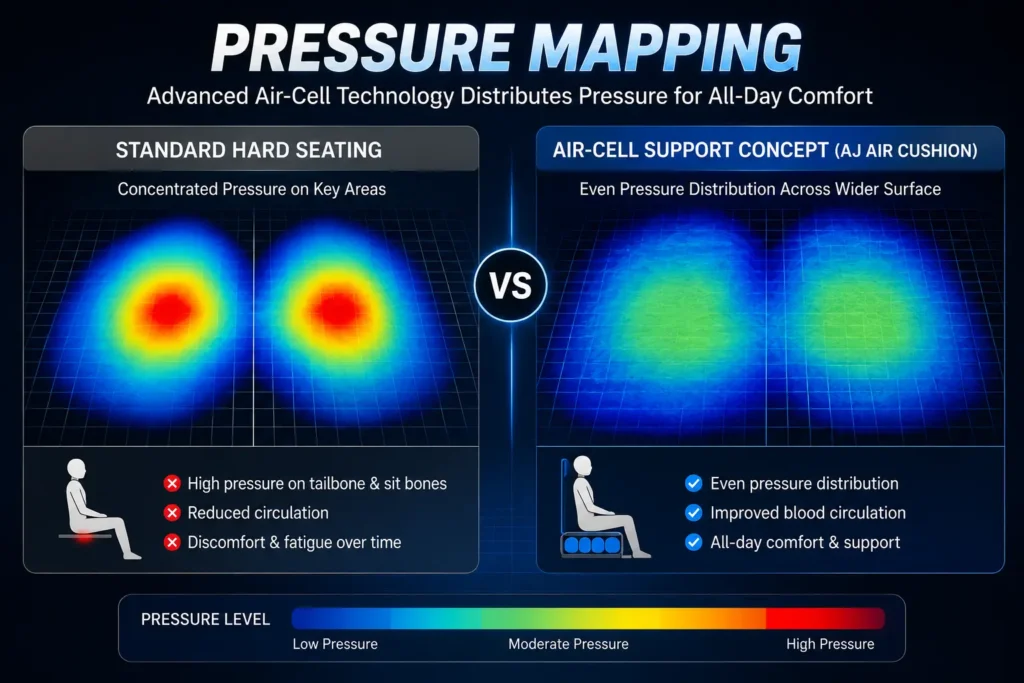
Interface pressure refers to the pressure measured where the body contacts a support surface.
When a person sits, the load is not distributed equally across the entire seating area. Anatomical regions such as the ischial tuberosities—the bony structures commonly referred to as the “sitting bones”—can create areas of higher localized pressure.
The goal of a pressure-redistributing cushion is not simply to make a seat softer. It is to manage the contact interface so that body weight is supported across a broader area and excessive localized loading is reduced.
This distinction matters.
A cushion that feels soft can still concentrate load in particular regions, while another cushion may feel relatively stable but distribute load more effectively.
Research by Gil-Agudo and colleagues compared several wheelchair cushions in individuals with spinal cord injury. In their study population, a dual-compartment air cushion produced the best pressure distribution and the largest body-to-cushion contact area among the cushions evaluated.
The study does not mean that every air cushion automatically performs better than every other material. It does, however, demonstrate why air-cell architecture deserves serious consideration when pressure distribution is a product-design objective.
Why Air Cells Behave Differently From Solid Cushion Materials
Traditional foam cushions primarily manage load through material deformation.
Air-cell systems operate differently.
When interconnected air chambers are used, the supporting medium can respond to changes in body position by transferring or redistributing air within the cushion structure. Instead of relying exclusively on the compression characteristics of a solid material, the system uses internal air volume and pressure as part of the support mechanism.
This creates several potential engineering advantages:
- greater conformity to variations in body shape;
- adjustable firmness through changes in internal air pressure;
- redistribution of load as the user’s position changes;
- reduced dependence on a single fixed foam density;
- the ability to engineer multiple cells or zones for different support objectives.
A 2024 feasibility study provides an advanced example of this principle. Researchers developed a smart cushion in which air cells functioned as both sensing and actuating elements. The system could detect pressure distribution and actively alter pressure across the seating surface. In testing involving people with spinal cord injuries, the pressure profiles generated by the cushion correlated strongly with a commercial pressure-mapping system, and pressure-modulation algorithms were able to reduce high-pressure regions.
That research involved an automated clinical prototype and should not be interpreted as product-specific evidence for conventional commercial air cushions. Its importance for the seating industry is broader: air is not merely padding. It can function as a controllable mechanical support medium.
What Comparative Research Says About Air Cushions
A rapid review published in Disability and Rehabilitation examined studies comparing wheelchair cushion types in individuals with spinal cord injury.
Across the research reviewed, air cushions were reported more consistently effective in reducing interface pressure than gel or polyurethane foam cushions. However, the authors also emphasized substantial variation between studies, including differences in body position, measurement equipment, cushion covers, participant characteristics, and testing duration.
This qualification is important for procurement professionals.
Material category alone does not determine performance.
Two products described as “air cushions” may use very different:
- cell geometries;
- cell counts;
- internal airway designs;
- inflation pressures;
- cover materials;
- surface contours;
- cushion heights;
- valve systems.
Consequently, B2B evaluation should focus on the complete seating system rather than the marketing label attached to one material.
Dynamic Support Matters Because People Do Not Sit Still
Human sitting is inherently dynamic.
Users lean forward, shift laterally, rotate their pelvis, reach for objects, reposition their legs, and change posture during the day.
Research has demonstrated that posture significantly changes seating-interface biomechanics. Earlier experimental work comparing air and polyurethane foam cushions found that ischial pressures changed as participants adopted different seated positions.
More recently, a six-month cluster-randomized trial involving office workers examined a dynamic seat cushion designed to promote postural shifts. Participants using the dynamic intervention experienced substantially lower incidence of newly developed neck and low-back pain than the control group during the study period. The researchers concluded that encouraging postural shifts may be an important element in reducing prolonged static sitting.
Again, this study evaluated a particular dynamic cushion and is not evidence that every air-cell product produces the same clinical effect.
The broader ergonomic implication is more relevant to B2B seating design:
A seating system should accommodate movement rather than assume that the human body remains mechanically static.
Adjustable Firmness Is More Than a Comfort Feature
People differ considerably in body weight, pelvic geometry, posture, clothing, seat type, and personal comfort preference.
A fixed-density foam cushion cannot change its mechanical properties after manufacturing.
An adjustable air cushion can.
Changing internal air volume changes how deeply the user immerses into the support surface and how the cushion responds to load.
This makes adjustability potentially valuable in B2B environments where one product platform may be used by a diverse population, including:
- trucking fleets;
- corporate offices;
- call centers;
- home-office programs;
- mobility retailers;
- automotive accessory channels;
- ergonomic-product distributors.
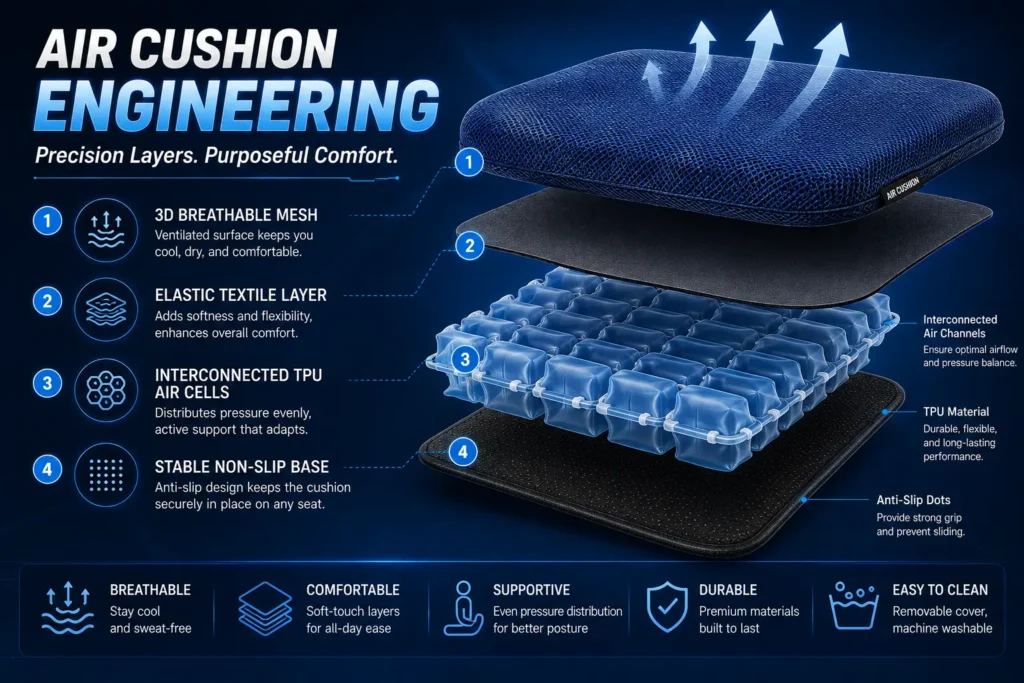
AJ AIR CUSHION’s current B2B platform, for example, uses 27 interconnected air cells together with built-in inflation and air-release controls, a removable breathable 3D mesh cover, TPU/Lycra construction, and a non-slip base.
From a procurement perspective, this represents an important difference between a passive fixed cushion and an adjustable support platform.
Pressure Distribution Is Only One Part of Seating Performance
Professional buyers should avoid evaluating a seat cushion using a single measurement.
An effective B2B product assessment may include:
Interface pressure
How concentrated or distributed is body-to-seat loading?
Contact area
How much of the body is effectively supported by the cushion?
Stability
Does the cushion remain positioned on common office, vehicle, or mobility seats?
Adjustability
Can users change firmness without replacing the cushion?
Thermal behavior
How does the seating interface manage heat and moisture?
Movement accommodation
How does the cushion respond when the user’s posture changes?
Cover construction
Is the cover breathable, removable, washable, and appropriate for the target market?
Commercial durability
Can the product withstand repeated inflation, loading, transportation, and everyday use?
These factors are particularly important for wholesale distributors because product success depends on more than laboratory pressure values. It must also work in real-world environments.
What the Research Does — and Does Not — Prove
Scientific credibility requires a clear boundary between category-level evidence and product-specific claims.
Much of the strongest published research on air-cell cushions has been conducted in wheelchair users, people with spinal cord injury, or controlled laboratory settings. Those findings help engineers understand pressure redistribution, but they cannot automatically be generalized to every office chair, vehicle seat, or commercial cushion.
Likewise, published evidence concerning one manufacturer’s cushion does not prove equivalent performance by another product.
For this reason, responsible B2B communication should use research to explain engineering principles, not to make unsupported claims that a commercial cushion diagnoses, treats, cures, or prevents a medical condition.
This distinction is especially important for brands entering healthcare-adjacent, mobility, or corporate-wellness channels.
The B2B Opportunity: From Cushion to Seating Platform
The air-cushion category is evolving from simple inflatable padding toward more sophisticated support platforms.
Advances in pressure mapping, interconnected chambers, responsive materials, smart sensing, and automated pressure modulation demonstrate where seating technology may move next.
For distributors and product developers, that creates opportunities beyond traditional ergonomic retail.
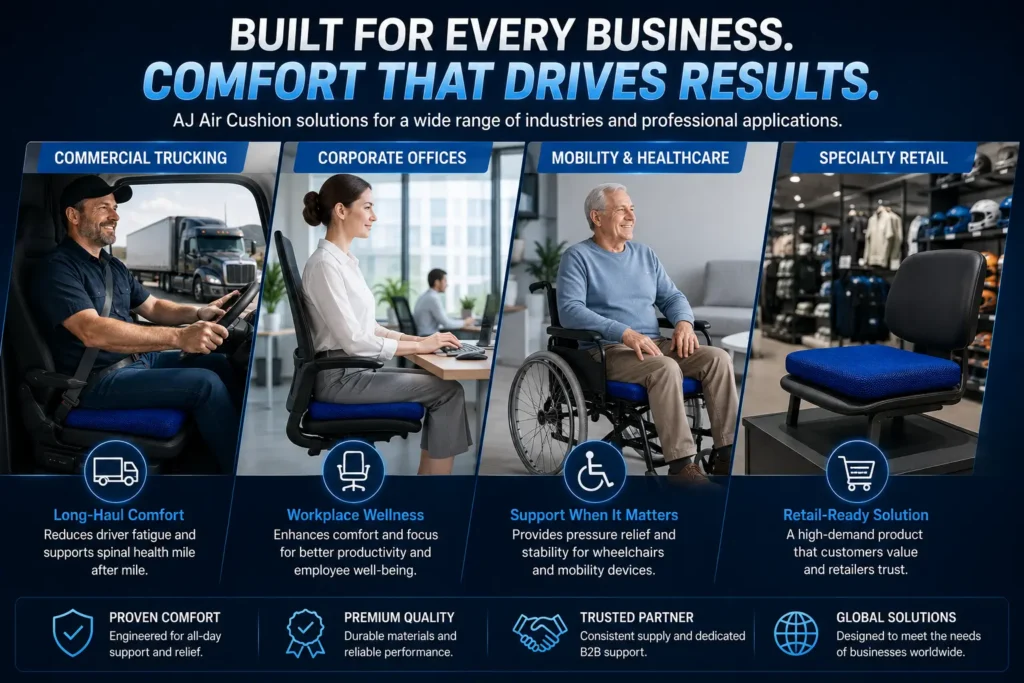
Potential applications include:
- professional-driver programs;
- fleet seating upgrades;
- corporate ergonomic purchasing;
- mobility and accessibility retail;
- travel seating;
- specialty automotive retail;
- OEM integration;
- private-label ergonomic programs.
AJ AIR CUSHION currently supports wholesale, retail, fleet, corporate, mobility, OEM, ODM, and private-label partnership models for these types of channels.
Conclusion
Air-cell cushion technology should not be understood simply as an alternative filling material.
Its primary engineering advantage lies in the ability to use controlled air volume and multi-cell architecture to create a responsive seating interface.
Peer-reviewed research shows that air-based cushion systems can provide effective pressure redistribution in certain populations and configurations, while newer research demonstrates the potential of air cells for dynamic and even automated pressure management.
For B2B buyers, the key question is therefore not:
“Is air better than foam?”
A more useful question is:
“How well has the complete seating system been engineered to manage pressure, movement, adjustability, stability, thermal comfort, and long-duration use?”
That is the standard against which modern seating technology should be evaluated.
Recommended Internal Links
Anchor: Patented Air Cushion Technology
→ /technology-patents/
Anchor: Explore AJ AIR CUSHION Products
→ /products/
Anchor: B2B & OEM Partnership Opportunities
→ /b2b-partnership/
Anchor: Commercial Seating Applications
→ /industries/
References
- Gil-Agudo A, de la Peña-González A, Del Ama-Espinosa A, et al. Comparative study of pressure distribution at the user-cushion interface with different cushions in a population with spinal cord injury. Clinical Biomechanics. 2009;24(7):558–563. DOI: 10.1016/j.clinbiomech.2009.04.006.
- He C, Shi P. Interface pressure reduction effects of wheelchair cushions in individuals with spinal cord injury: a rapid review. Disability and Rehabilitation. 2022;44(6):827–834. DOI: 10.1080/09638288.2020.1782487.
- Nasirian A, Erel V, Nuthi P, et al. Smart seat cushion feasibility pilot study: automated interface pressure modulation of individuals with spinal cord injury. Disability and Rehabilitation: Assistive Technology. 2024;19(8):3100–3109. DOI: 10.1080/17483107.2024.2349712.
- Channak S, Speklé EM, van der Beek AJ, Janwantanakul P. The effectiveness of a dynamic seat cushion in preventing neck and low-back pain among high-risk office workers: a 6-month cluster-randomized controlled trial. Scandinavian Journal of Work, Environment & Health. 2024;50(7):555–566. DOI: 10.5271/sjweh.4184.
Evaluate Air-Cell Seating for Your Market
Compare product options, quantities and customization requirements with our team. Request wholesale, OEM or private-label information.