
Choosing the right OEM air seat cushion manufacturer involves more than comparing unit prices. For distributors, private-label brands, retailers and commercial buyers, the manufacturer must be able to support product development, sampling, material selection, quality control, packaging and scalable production.
A reliable manufacturing partner should also provide clear information about minimum order quantities, sample lead times, production schedules and customization limitations before an order is confirmed. This guide explains the main factors B2B buyers should evaluate when sourcing an OEM or private-label air seat cushion.
Define Your Product Requirements Before Contacting Manufacturers
Before requesting a quotation, prepare a basic product specification. This helps manufacturers assess feasibility and provide more accurate pricing.
- Intended market and seating environment
- Product dimensions and target weight
- Air-cell structure and adjustment method
- Cushion-cover material
- Color and pattern requirements
- Logo placement
- Packaging, labels and instruction requirements
- Estimated order quantity and delivery destination
Commercial-driver products, office-seat cushions, mobility seating and retail consumer products may require different materials, packaging and performance priorities. A clear specification also makes it easier to compare quotations from different suppliers on an equivalent basis.
Evaluate the Air-Support Technology
Not every air cushion uses the same internal structure. Buyers should understand how air moves within the cushion, how firmness is adjusted and whether the design can maintain stable support during extended sitting.
- Are the air cells interconnected or individually sealed?
- How can users adjust firmness?
- Is a separate external pump required?
- What materials are used in the inflatable structure?
- Can the cushion be repeatedly inflated and deflated?
- Does the manufacturer hold patents related to the design?
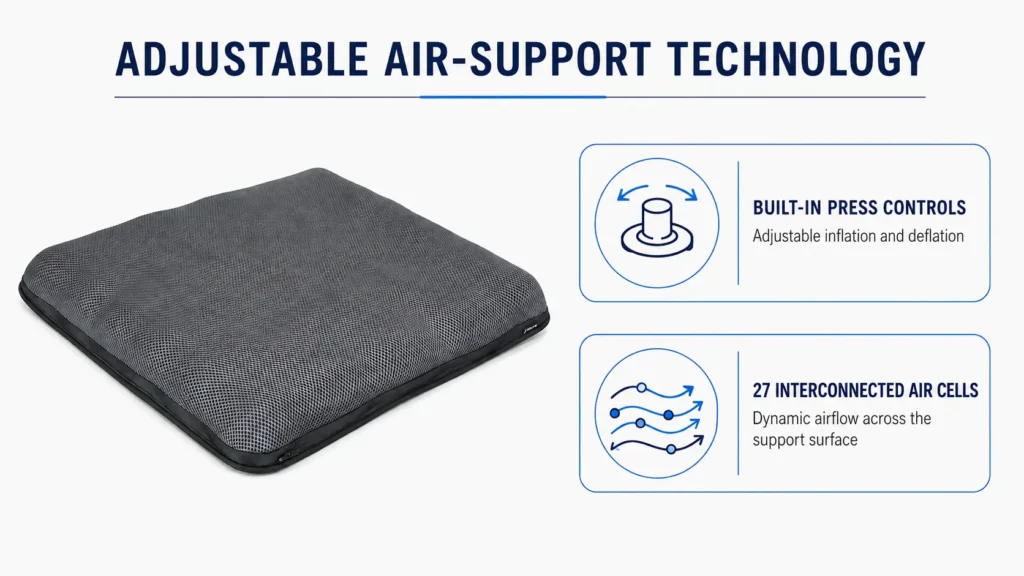
AJ AIR CUSHION products use an interconnected multi-cell air-support structure with built-in press controls. The adjustable design allows users to change the air level according to the chair, environment and individual comfort preference.
AJ AIR CUSHION technology is supported by U.S. patents US 11,639,041 B2, US 12,234,880 B2 and US 12,349,800 B2. Patent ownership does not replace product testing, but it can help buyers distinguish proprietary product development from generic catalog sourcing.
Review Materials and Product Construction
Material selection affects durability, breathability, cleaning requirements, appearance and cost. For an air seat cushion, buyers should review both the internal inflatable component and the removable outer cover.
- TPU air-cell material
- Bonding or sealing consistency
- 3D breathable mesh
- Lycra or flexible surface materials
- Zippers and stitching
- Edge binding
- Nonslip bottom construction
- Washable-cover instructions
Request close-up photographs or physical samples before approving mass production. Product images alone may not reveal stitching quality, material thickness or the performance of the inflation components. Manufacturers should also confirm which materials can be changed for an OEM project and which components must remain standard.
Confirm Sampling and Prototype Capabilities
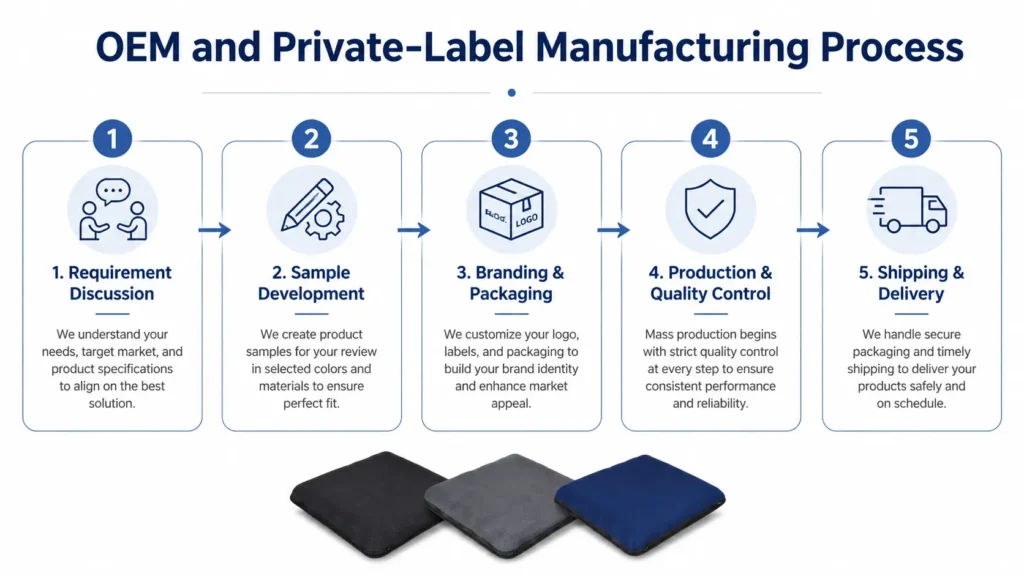
A physical sample is essential before placing a production order. Samples allow buyers to inspect dimensions, weight, cushion shape, air adjustment, surface comfort, fabric color, logo position, packaging, labels and printed materials.
For a standard AJ AIR CUSHION model, samples are available with applicable sample and shipping charges. The normal sample lead time is approximately 7–10 days, depending on availability and customization.
Custom prototypes may require additional time if the project involves new colors, printed fabrics, packaging, labels or product specifications. Buyers should document all requested revisions and obtain a final approved sample or specification before production begins.
Understand MOQ and Production Scalability
Minimum order quantity should be evaluated together with customization requirements. A low MOQ may apply only to standard products, while custom fabrics, packaging and printed components can have separate minimum quantities.
- MOQ per model
- MOQ per color or pattern
- MOQ for custom packaging and labels
- Whether mixed colors are allowed
- Whether sample charges can be credited
- Pricing at different order quantities
AJ AIR CUSHION’s standard MOQ starts at 100 pieces per model. Final requirements depend on the materials, colors, packaging and customization requested. Buyers should avoid selecting a supplier based only on the lowest MOQ; the manufacturer must also maintain consistent specifications when order volume increases.
Examine OEM and Private-Label Options
OEM and private-label services can range from simple logo application to complete product development. Available customization may include:
- Brand logo
- Product colors
- Printed patterns
- Woven or printed labels
- Packaging boxes and polybags
- Instruction sheets and product inserts
- Barcodes and carton markings
- Selected product specifications
Confirm which elements are included in the quotation and which require separate setup, tooling or artwork charges. Buyers should provide production-ready artwork whenever possible. Logo colors, dimensions, placement and printing method should be approved before mass production.
Verify Quality-Control Procedures
Quality control should cover more than the appearance of the finished cushion. Depending on the product and order requirements, inspection points may include:
- Air leakage
- Inflation and deflation function
- Sealing consistency
- Dimensions and weight
- Cover stitching and zipper operation
- Fabric color and logo position
- Packaging contents
- Carton quantity and shipping marks
Ask whether inspections are performed during production, before packing or only after completion. For larger or market-specific orders, buyers may also arrange an independent pre-shipment inspection. The inspection standard should be agreed upon before production begins.
Confirm Lead Times, Payment and Shipping Responsibilities
A professional quotation should clearly separate sample development, production and shipping schedules.
- Sample lead time: approximately 7–10 days
- Bulk production: approximately 30 days after final approval
- Payment: T/T according to the formal quotation
Actual timing may vary according to quantity, customization, material availability and packaging requirements. Buyers should also confirm Incoterms, delivery location, carton specifications, freight responsibilities, required shipping documents, inspection timing and balance-payment conditions.
Do not rely on an estimated delivery date until product specifications, artwork, payment terms and shipping arrangements have been confirmed.
Review Communication and Documentation
Reliable communication is an important part of manufacturing risk management. The supplier should provide written confirmation of the final product specification, approved sample, materials and colors, packaging requirements, order quantity, unit price, production lead time, payment terms, inspection requirements and shipping terms.
Changes should not be handled only through informal messages. Important approvals should be recorded in the quotation, specification sheet or purchase order. Clear documentation reduces misunderstandings and provides a reference for final inspection.
OEM Manufacturer Evaluation Checklist
Before selecting an OEM air seat cushion manufacturer, confirm that the supplier can provide:
- A clear product and material specification
- Physical samples
- Transparent MOQ requirements
- Defined customization options
- Patent or technical information where applicable
- Quality-control procedures
- Realistic production schedules
- Formal pricing and payment terms
- Packaging and labeling support
- Consistent written communication
The best manufacturing partner is not necessarily the supplier offering the lowest unit price. Product reliability, communication, documentation and production consistency can have a greater effect on the long-term success of a B2B program.
Discuss Your OEM or Private-Label Project
AJ AIR CUSHION works with distributors, retailers, commercial buyers and private-label partners seeking adjustable air-support seating products.
Standard MOQ starts at 100 pieces per model. Samples, custom branding, packaging, colors, patterns and selected product specifications can be evaluated according to project requirements.
Discuss your wholesale, OEM or private-label requirements with AJ AIR CUSHION: https://ajaircushion.com/contact-wholesale/